
On-Chip Offline Neuromorphic Computing
Team
- E/20/346, S.M.P.H. Samarakoon, e20346@eng.pdn.ac.lk
- E/20/419, Wakkumbura M.M.S.S., e20419@eng.pdn.ac.lk
- E/20/439, Wickramasinghe J.M.W.G.R.L., e20439@eng.pdn.ac.lk
Supervisors
- Dr. Isuru Nawinne, isurun@eng.pdn.ac.lk
- Prof. Roshan G. Ragel, roshanr@eng.pdn.ac.lk
Table of Contents
- Abstract
- Related Works
- Methodology
- Experiment Setup and Implementation
- Results and Analysis
- Conclusion
- Publications
- Links
Abstract
Neuromorphic computing offers a brain-inspired paradigm for energy-efficient machine intelligence, using sparse, event-driven spike signals instead of dense floating-point activations. However, most existing neuromorphic systems rely on off-chip training or static, pre-trained weight deployment. This project presents a fully on-chip, offline-capable Spiking Neural Network (SNN) training system implemented on an FPGA SoC.
The system integrates a custom hardware inference accelerator based on Leaky Integrate-and-Fire (LIF) neurons, an on-chip surrogate gradient lookup table, and a RISC-V processor extended with six custom backpropagation instructions. Together, these components execute the complete learning loop — forward inference, surrogate gradient computation, and weight updates via backpropagation — entirely in hardware without any host-side involvement.
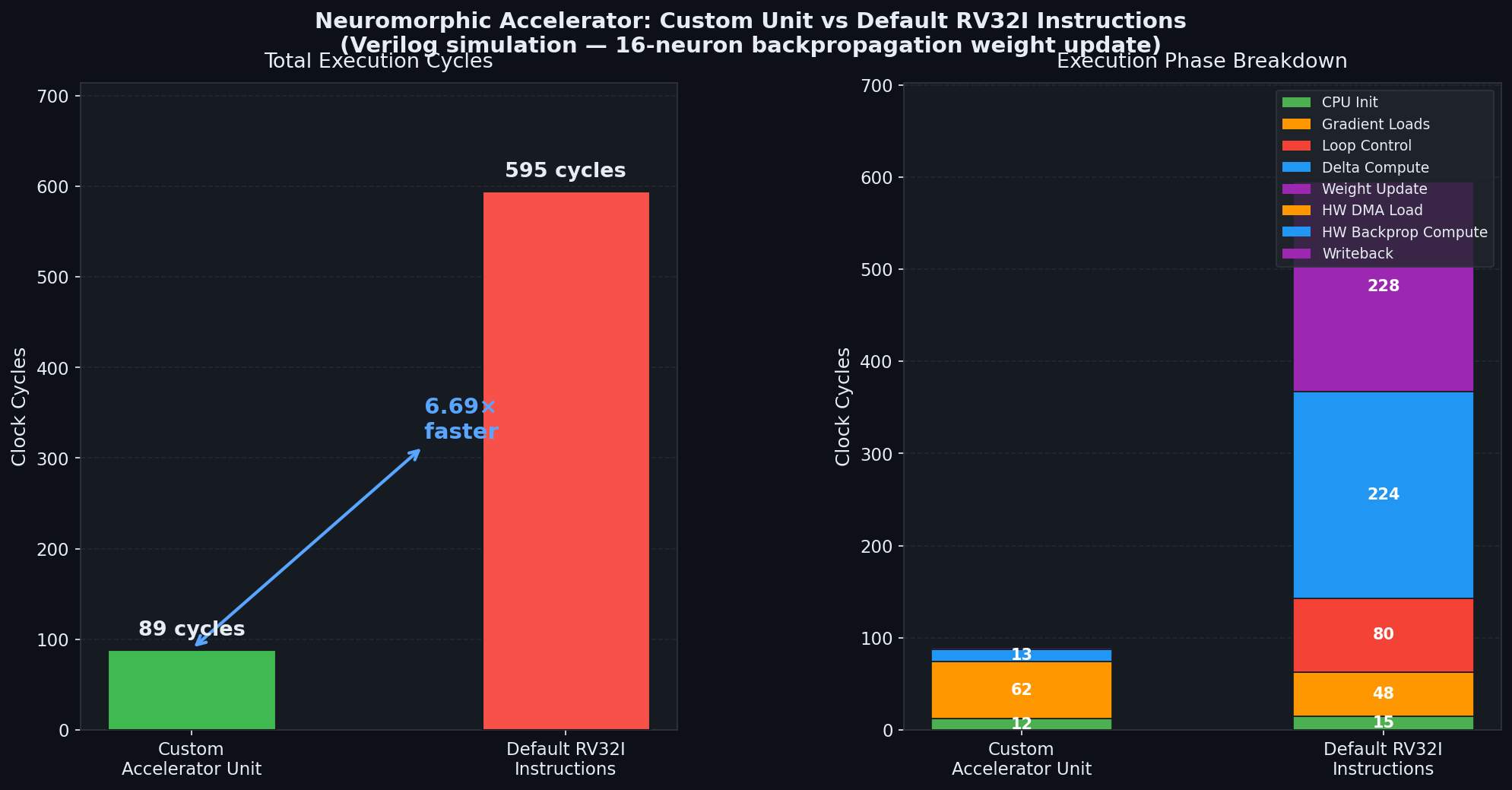
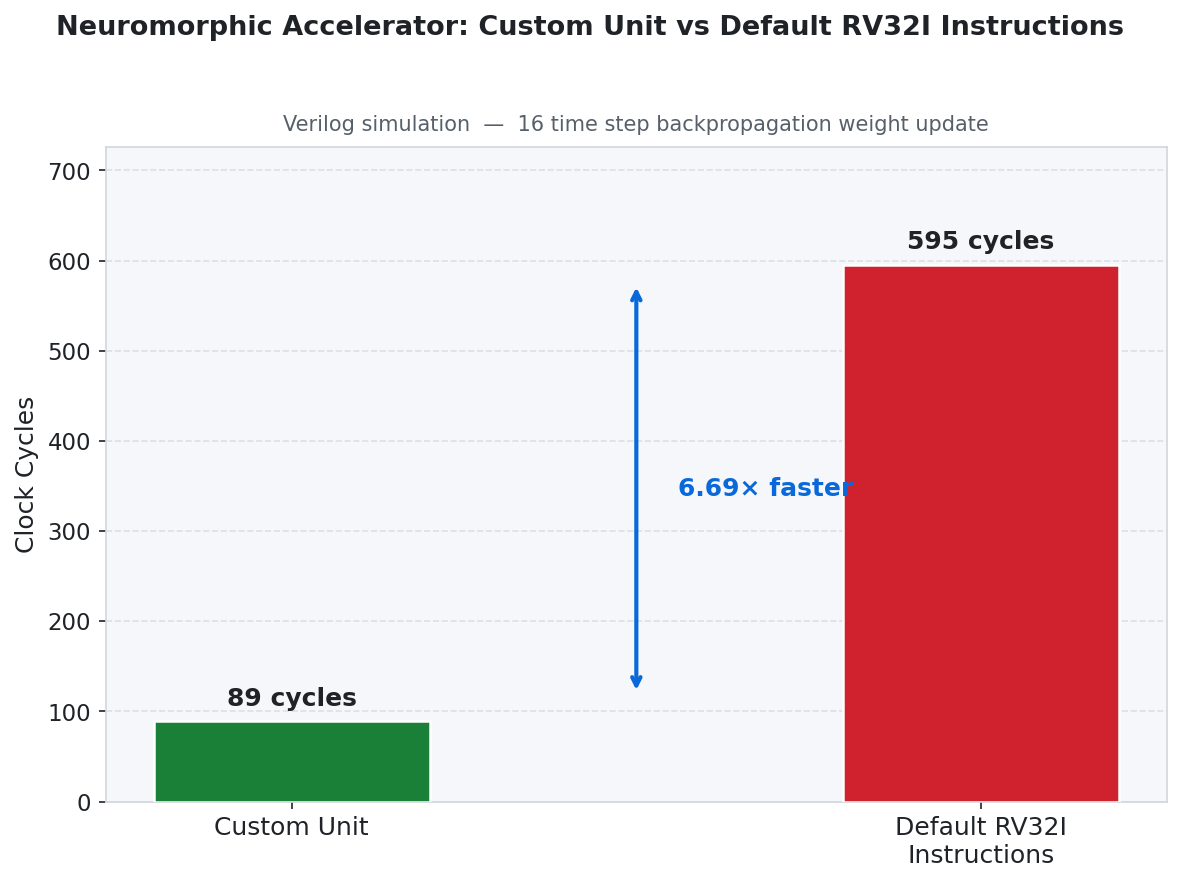
The system is validated on MNIST digit classification using a 784 → 200 → 10 SNN architecture with Q16.16 fixed-point arithmetic. The custom hardware extensions achieve a 6.69× speedup over a pure-software baseline (89 cycles vs 595 cycles per weight update) and reach 86.50% classification accuracy after five training epochs on the 60,000-sample MNIST training set.
Related Works
Spiking Neural Networks have been studied extensively as biological neural models and energy-efficient alternatives to rate-coded artificial neural networks. Key related areas include:
- Surrogate gradient methods — The non-differentiable spike function is replaced with a smooth surrogate in the backward pass, enabling standard gradient-based optimisation for SNNs (Neftci et al., 2019; Zenke & Ganguli, 2018).
- Neuromorphic chips — Dedicated neuromorphic ASICs such as Intel Loihi, IBM TrueNorth, and SpiNNaker support spike-based inference but typically require off-chip training.
- On-chip learning in SNNs — Spike-Timing-Dependent Plasticity (STDP) has been explored for on-chip unsupervised learning. This project extends the landscape by enabling supervised backpropagation directly in hardware.
- RISC-V custom instruction extensions — Domain-specific RISC-V ISA extensions have been used to accelerate neural network inference (e.g., NVDLA-style accelerators), and this work applies the same concept to the training phase.
- FPGA-based SNN accelerators — Prior work on FPGA deployment of SNNs focuses primarily on inference; this project adds on-chip weight adaptation as a novel contribution.
Methodology
Neuron Model
The system uses the Leaky Integrate-and-Fire (LIF) neuron model. At each discrete timestep:
V_mem[t] = β × V_mem[t-1] + Σ(w_i × spike_i[t])
if V_mem[t] ≥ V_threshold:
    spike_out = 1,  V_mem = 0  (reset)
else:
    spike_out = 0
where β = 192/256 ≈ 0.75 is the leak factor and all values are Q16.16 fixed-point.
Surrogate Gradient
Because the Heaviside spiking function is non-differentiable, a 256-entry Q16.16 ROM LUT stores pre-computed surrogate gradient values (smooth approximation of the sigmoid derivative). The LUT index is derived from the neuron’s membrane potential V_mem.
Backpropagation
Weight updates use a surrogate-gradient backpropagation rule with momentum:
δ = ((error + 0.95 × δ_prev) × surrogate_grad × spike_status) >> 8
W' = W − (LR × δ) >> 8      (LR = 150/256 ≈ 0.586)
This computation is accelerated by the custom RISC-V backprop unit, which includes two PISO LIFO buffers (one for spike status, one for gradients) and a DMA-style Memory-to-LIFO Loader FSM.
Three-State On-Chip Pipeline
The full on-chip learning loop operates as three sequential states per training sample:
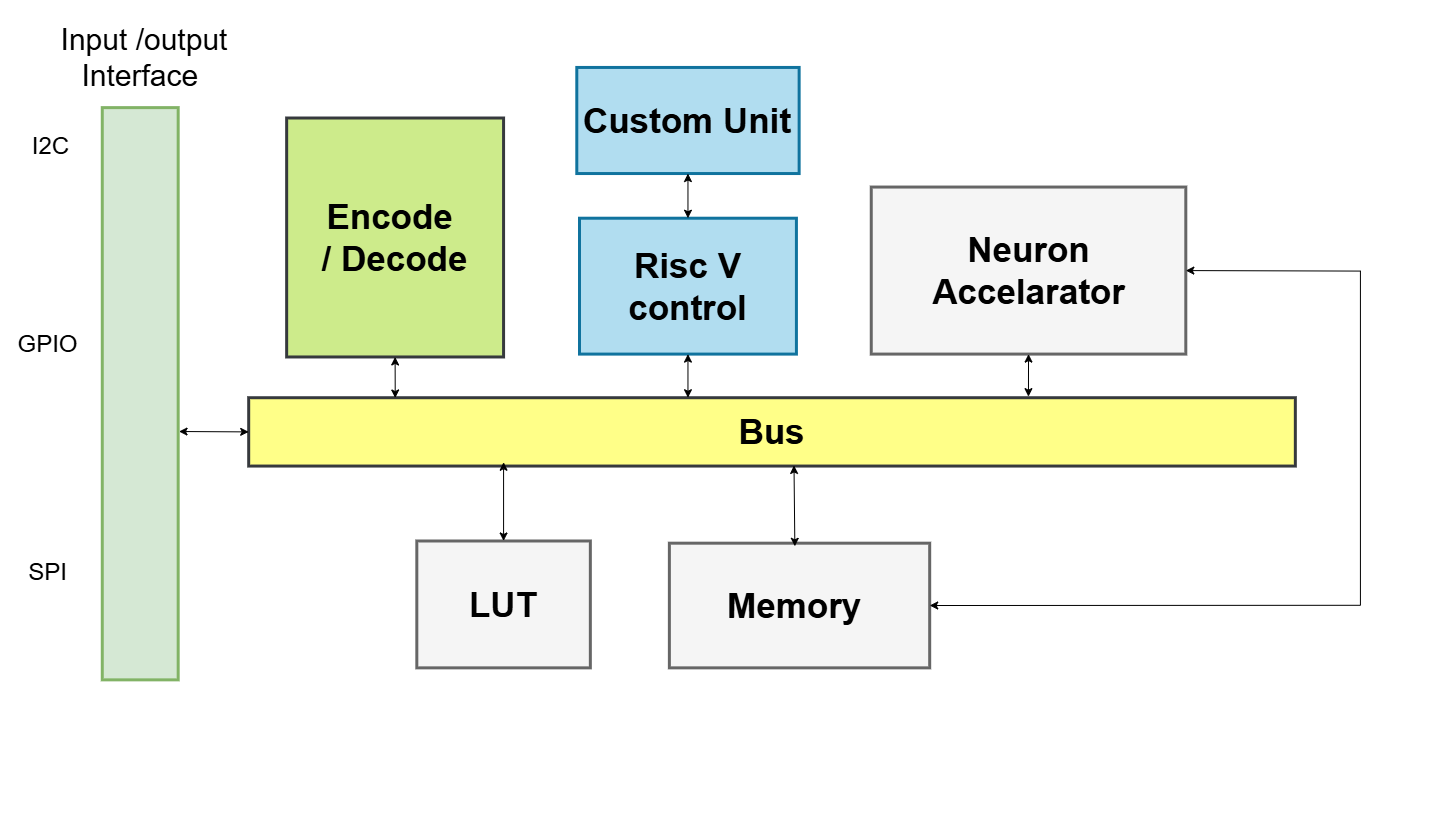
The SoC connects all major blocks over a shared Wishbone bus: the RISC-V control CPU with its Custom Backprop Unit, the Neuron Accelerator (LIF inference hardware), the Surrogate Gradient LUT (256-entry ROM), and Shared Memory (dual-port BRAM). An Encode/Decode block bridges the internal bus to external I/O peripherals (I2C, GPIO, SPI).
| State | Executor | Function |
|---|---|---|
| 1 — Inference | Hardware accelerator (RTL) | LIF neuron forward pass; spike and V_mem written to shared BRAM |
| 2 — Surrogate Substitution | RISC-V CPU | Reads V_mem from BRAM, queries LUT, writes surrogate gradients back |
| 3 — Learning | RISC-V CPU + custom ISA | Backpropagation weight updates via 6 custom hardware instructions |
Custom RISC-V ISA Extensions
Six new instructions (opcode 7'b0001011) were added to the RV32IM pipeline:
| Instruction | Purpose |
|---|---|
LIFOPUSH |
Push spike/gradient data into hardware LIFO buffers |
LIFOPOP |
Pop LIFOs, load weight and error, start computation |
BKPROP |
Trigger backprop computation without reloading weight |
LOADWT |
Load a new weight mid-computation |
LIFOPUSHM |
DMA-style BRAM-to-LIFO data transfer |
LIFOWB |
Write computed updated weight from HW unit back to register file |
Experiment Setup and Implementation
Hardware Platform
- Target: FPGA SoC (RV32IM processor + custom RTL accelerator)
- SoC framework: LiteX / Migen
- On-chip bus: Wishbone
- CPU: Custom 5-stage pipelined RV32IM (Verilog), extended with backprop instructions
- Number format: Q16.16 fixed-point (32-bit)
- Simulation: Icarus Verilog (
iverilog/vvp) and Synopsys VCS
SNN Network Configuration
| Parameter | Hardware Trainer | Python Trainer |
|---|---|---|
| Architecture | 784 → 200 → 10 | 784 → 16 → 10 |
| Neuron model | LIF24 (β ≈ 0.75) | LIF2 (β = 0.5) |
| Timesteps | 16–25 | 16 |
| Epochs | 5 | 10 |
| Training samples | 60,000 (MNIST) | 60,000 (MNIST) |
Hardware Resource Estimate
| Component | Resource |
|---|---|
| LIFO Buffers | ~2 KB |
| Custom Backprop Unit | ~500 LUTs |
| Memory Loader FSM | ~200 LUTs |
| Surrogate LUT ROM | 256 × 32-bit |
| Total overhead over base RV32IM | ~10% additional |
RTL Test Suite
| Level | Test | Result |
|---|---|---|
| L2a | Neuron cluster spike + V_mem (8 checks) | PASS |
| L2b | Cluster v_pre_spike port wiring (4 checks) | PASS |
| L4 | Accelerator known-value dump (6/7 checks) | PASS |
| L5 | SNN inter-cluster propagation + dump (8 checks) | PASS |
| L6 | Accelerator + real Wishbone BRAM (10 checks) | PASS |
| L7 | STATE 2 surrogate substitution (8 checks) | PASS |
| L8 | Full pipeline: CPU + accelerator + BRAM + LUT | In progress |
Results and Analysis
Benchmark: Cycle Count Comparison
The custom hardware backprop unit was benchmarked against an equivalent pure-software RV32I implementation for a 16-timestep weight update:
| Implementation | Total Cycles | Time @ 100 MHz |
|---|---|---|
| Custom Accelerator | 89 | 890 ns |
| Standard RV32I | 595 | 5,950 ns |
| Speedup | 6.69× | — |
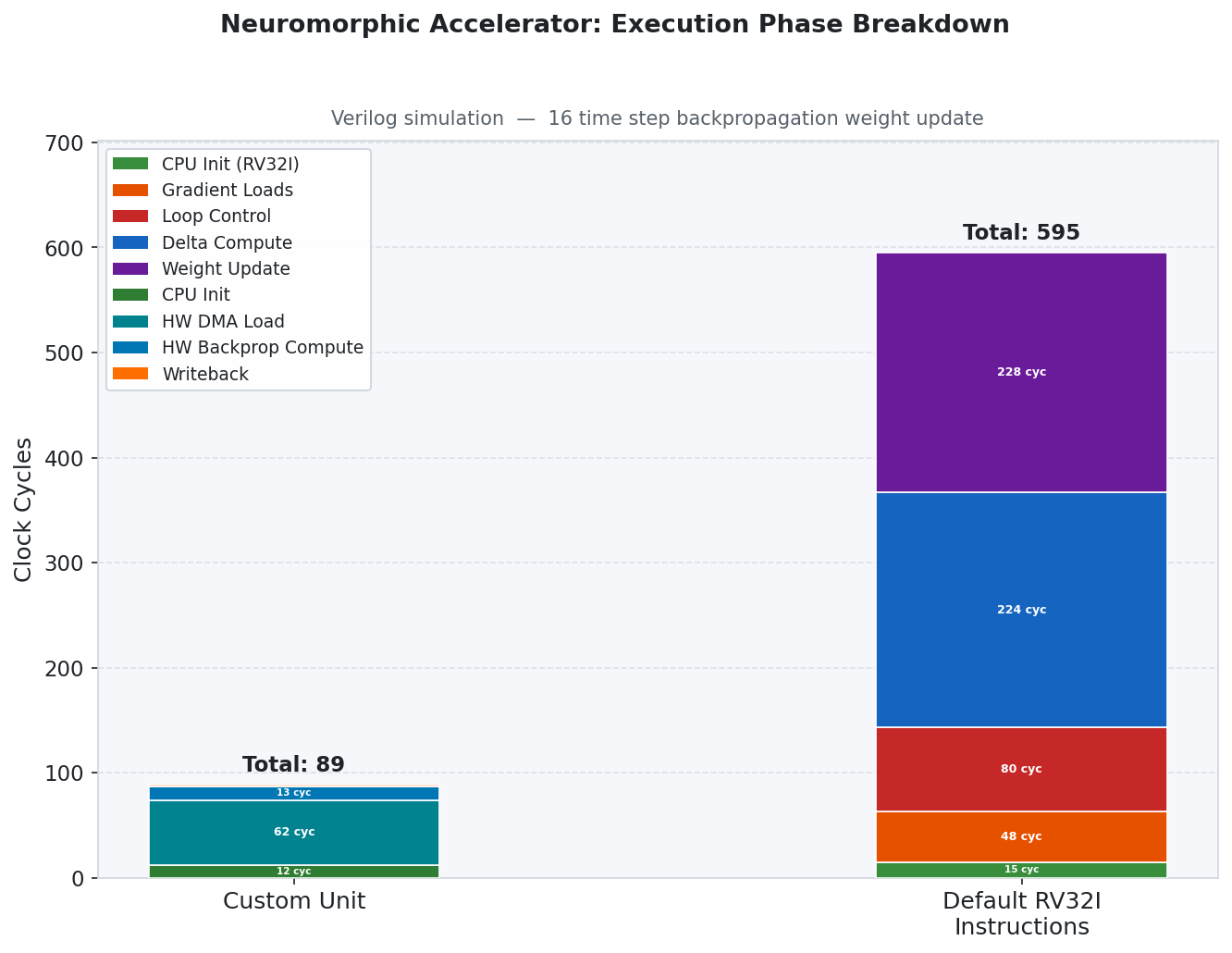
Phase-by-Phase Breakdown
| Phase | Custom Accelerator | Standard RV32I |
|---|---|---|
| CPU Initialization | 12 cycles | 15 cycles |
| Data Load (DMA / Gradient Loads) | 62 cycles | 48 cycles |
| Delta Computation | 13 cycles | 224 cycles |
| Weight Update | 2 cycles | 228 cycles |
| Loop Control | — | 80 cycles |
The primary speedup comes from the hardware delta computation and weight update stages, which are reduced by 17× and 114× respectively.
MNIST Classification Accuracy
Hardware-Matched C Trainer (784 → 200 → 10)
| Epoch | Accuracy |
|---|---|
| 1 | 67.69% |
| 2 | ~83.0% |
| 5 | 85.74% |
| Peak | 86.50% |
Python SNN Trainer (784 → 16 → 10)
| Epoch | Accuracy |
|---|---|
| 1 | ~33.0% |
| 10 | 78.50% |
| Peak | 80.90% |
On-Chip Output-Layer Learning: Softmax vs Perceptron
After the SNN’s hidden layers are trained, two lightweight output-layer learning strategies are evaluated for on-chip adaptation:
Softmax Learning converts the 10 output neuron responses (accumulated spike counts over all timesteps) into a probability distribution using the softmax function, then minimises cross-entropy loss via gradient descent. This provides smooth, calibrated class probability estimates and is mathematically equivalent to training a soft linear classifier on top of the SNN’s spike representations.
Perceptron Learning applies a hard, error-driven weight update directly to the output weights: if the predicted class is wrong, weights for the correct class are nudged upwards and weights for the wrong class are nudged downwards in proportion to the input spike rate. No probability computation is required — the rule needs only comparisons and additions, making it extremely compact and well suited for on-chip execution with minimal hardware overhead.
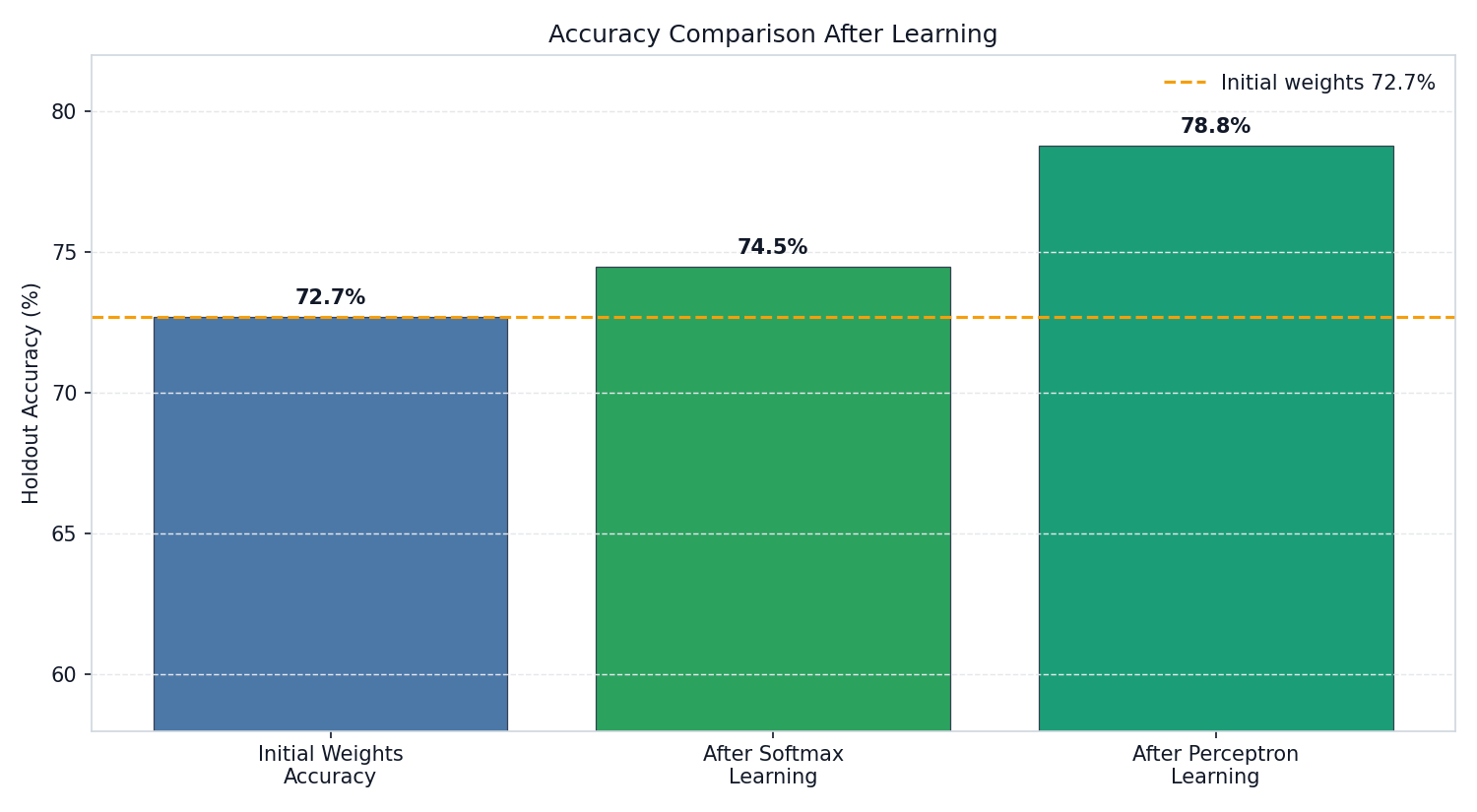
Starting from a pre-trained baseline of 72.7% holdout accuracy, Softmax Learning improves to 74.5% (+1.8 pp) while Perceptron Learning reaches 78.8% (+6.1 pp), demonstrating that the simpler hardware-friendly rule achieves greater adaptation benefit.
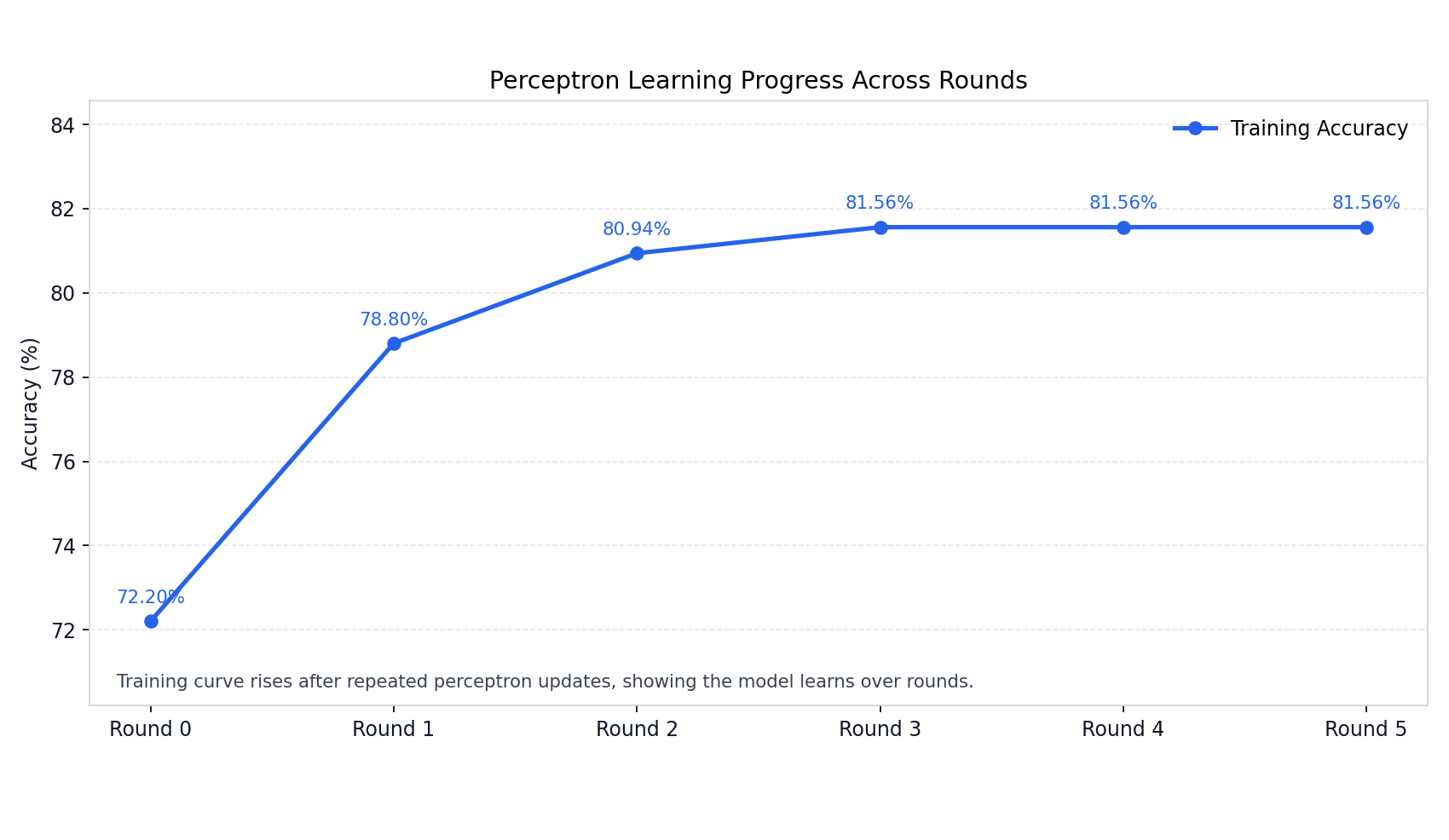
The Perceptron learning curve shows rapid convergence: accuracy rises sharply from 72.2% at Round 0 to 81.56% by Round 3, then plateaus — indicating that only a small number of on-chip replay passes are needed to fully exploit the learned spike representations.
Weight Update Stability
A 32-sample replay learning step on the converged model showed:
| Weight Matrix | Weights Changed | Max Absolute Diff | Notes |
|---|---|---|---|
| W1 (156,800 weights) | 0 | 0 | Stable / frozen |
| W2 (2,000 weights) | 450 | 1 | Fine-grained adaptation |
This confirms the system converges stably and that the custom weight update hardware produces correct, bounded updates.
Conclusion
This project demonstrates that a complete SNN training loop — inference, surrogate gradient computation, and backpropagation — can be executed fully on-chip on an FPGA SoC with no host-side involvement. Key achievements:
- A 6.69× hardware speedup for per-weight backpropagation using 6 custom RISC-V instructions and dedicated hardware units
- 86.50% MNIST accuracy using the hardware-matched C trainer after 5 epochs
- A validated RTL test suite passing L2 through L7 (14 test cases across 6 levels)
- A complete hardware-software co-design integrating a custom LIF accelerator, surrogate LUT, dual-port BRAM, and extended RISC-V CPU on a Wishbone SoC fabric
Future work includes completing the L8 full-pipeline integration test, scaling to larger SNN architectures, and targeting an actual FPGA deployment.