
Patient Management System
Team
- E/22/364 – S.M.L.E Senadhipathi (e22364@eng.pdn.ac.lk)
- E/22/125 – D.D.S.K. Gunawardhana (e22125@eng.pdn.ac.lk)
- E/22/159 – G.K.M. Jayanga (e22159@eng.pdn.ac.lk)
- E/22/004 – D.D. Abeysinghe (e22004@eng.pdn.ac.lk)
Table of Contents
- Introduction
- Solution Architecture
- Software Designs
- Testing
- Technology Stack
- Deployment
- Conclusion
- Links
Introduction
Healthcare facilities still face problems such as paper-based records, scattered patient information, appointment conflicts, and limited access to medical history. These issues can lead to delays in treatment, data loss, and poor patient experience.
The Patient Management System (PMS) is a full-stack web application designed to manage patient records, medical history, appointments, billing, pharmacy, and clinical workflows in a centralized system. The system provides a secure, role-based platform for healthcare staff and patients to access and update information efficiently.
The system supports 10 distinct user roles — Super Admin, Admin, Management, Doctor, Nurse, Receptionist, Pharmacist, Lab Technician, Billing Staff, and Patient — each with a dedicated dashboard and tailored permissions. It improves data accuracy, reduces manual work, and supports better decision-making by healthcare providers.
Solution Architecture
Architecture Overview
The system follows a three-tier client-server architecture with a clear separation between the presentation, business logic, and data layers.
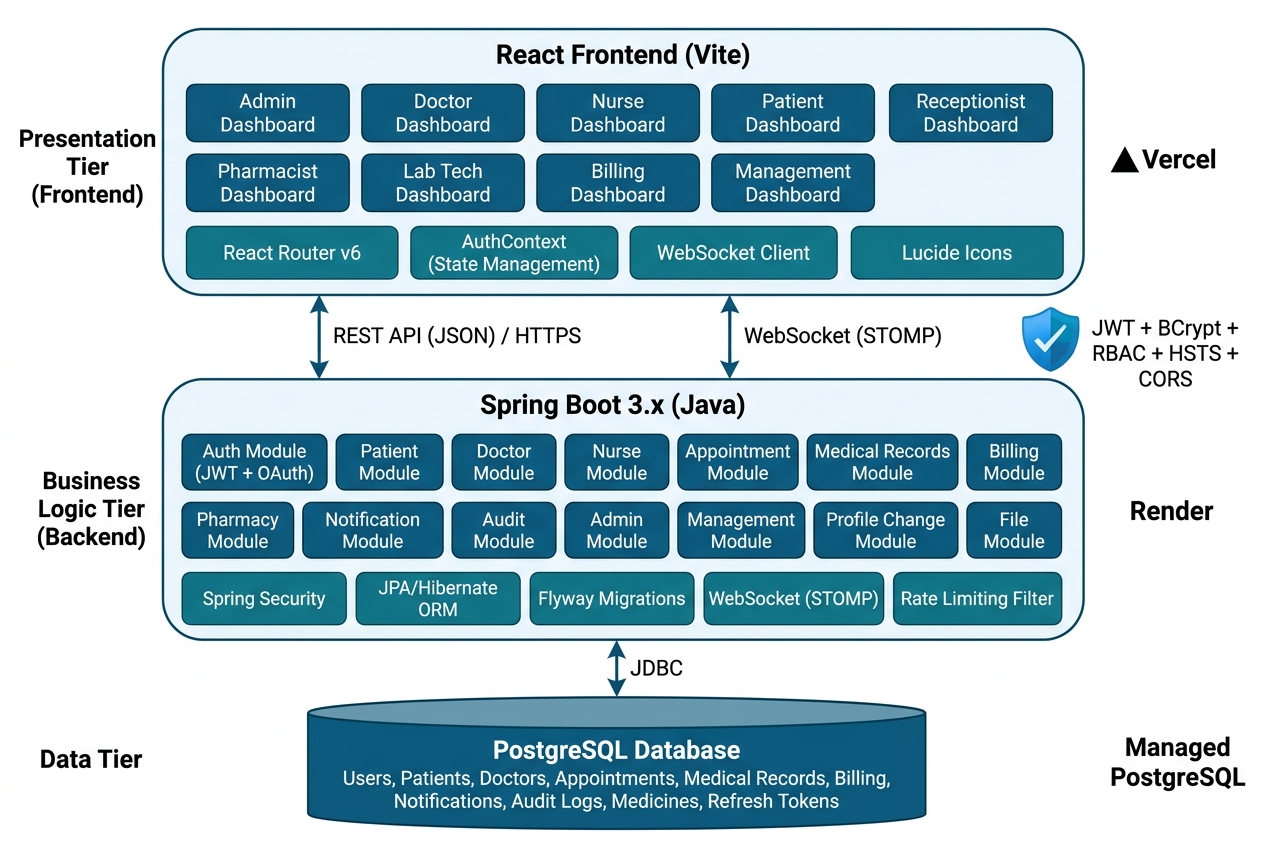
Frontend (React + Vite)
- Single-page application with role-based routing and dashboards
- 10 role-specific dashboard views with dedicated sub-components
- Patient registration, appointment scheduling, billing, and medical record interfaces
- Real-time notifications via WebSocket
- Responsive UI built with Tailwind CSS
Backend (Spring Boot)
- 18 modular packages following a layered architecture (Controller → Service → Repository → Entity)
- RESTful API endpoints with method-level security (
@PreAuthorize) - JWT-based stateless authentication with refresh token support
- OTP-based email verification via Resend API
- Rate limiting filter to prevent brute-force attacks
- WebSocket support for real-time notifications
- Flyway database migrations for version-controlled schema management
Database (PostgreSQL)
- Stores patient data, medical records, appointments, billing (invoices, pending items), pharmacy (medicines), notifications, audit logs, and user data
- Managed schema migrations via Flyway
- SSL-enforced connections in production
Security
- JWT access tokens + refresh tokens for stateless authentication
- BCrypt password hashing
- Role-based access control (RBAC) with 10 roles
- Email OTP verification for signup
- Account lockout after failed login attempts
- Rate limiting on authentication endpoints
- CORS configuration and security headers
- HTTPS-enforced communication in production
Software Designs
1. System Modules
1.1 Patient Management Module
- Create, update, and search patient records
- Store demographic and emergency contact details
- Handle duplicate patient detection
- Patient self-service dashboard for viewing records and booking appointments
1.2 Medical Records Module
- Store medical history, allergies, diagnoses, and treatments
- Manage prescriptions and clinical notes
- Attach and manage medical documents and reports (file upload service)
- Support multiple record types (Lab Results, Prescriptions, Clinical Notes, etc.)
1.3 Appointment Management Module
- Schedule, reschedule, and cancel appointments
- Track appointment history and attendance
- Manage provider (doctor) availability
- Patient-facing appointment booking interface
- Receptionist scheduling and overview panels
1.4 User & Access Control Module
- User signup with OTP email verification
- Login with email/password and Google authentication
- Role-based access with 10 roles: Super Admin, Admin, Management, Doctor, Nurse, Receptionist, Pharmacist, Lab Technician, Billing Staff, Patient
- Admin-managed user approval and activation/deactivation
- Profile change request workflow
- Audit logs for all data access and changes
1.5 Billing & Invoicing Module
- Pending bill item management (charges added by doctors, nurses, pharmacists)
- Invoice generation and finalization
- Line-item invoice breakdown
- Billing staff dashboard with full billing pipeline
- Receptionist billing overview and invoice creation
- Payment tracking and billing history
1.6 Pharmacy Module
- Medicine inventory management
- Prescription-linked dispensing workflow
- Pharmacist dashboard for managing prescriptions
1.7 Lab & Diagnostics Module
- Lab technician dashboard for entering and managing lab results
- Integration with medical records for result attachment
1.8 Notification Module
- In-app notifications with multiple notification types
- Real-time delivery via WebSocket
- Notification history and management
1.9 Reporting & Management Module
- Management dashboard with user and staff management
- Administrative and statistical reports
- Patient summaries and clinical reports
2. Database Design
Key Entities
- User – id, firstName, lastName, email, mobileNumber, passwordHash, role, isActive, emailVerified, failedLoginAttempts, lockedUntil, createdAt, updatedAt
- Patient – Demographic details, emergency contacts, linked user account
- Appointment – Patient, doctor, date/time, status, notes
- MedicalRecord – Patient-linked records with record types (Lab Results, Prescriptions, Clinical Notes, etc.)
- Invoice – Patient-linked invoices with line items and totals
- InvoiceItem – Individual charges within an invoice
- PendingBillItem – Charges awaiting invoice finalization
- Medicine – Pharmacy inventory with name, dosage, and stock
- Notification – User notifications with type and read status
- AuditLog – Action tracking for data access and modifications
- EmailOtp – OTP codes for email verification
- RefreshToken – JWT refresh token storage
Relationships
- One user → one role (enum-based)
- One patient → many appointments
- One patient → many medical records
- One patient → many invoices
- One invoice → many invoice items
- One patient → many pending bill items
- One user → many notifications
- One user → many audit log entries
3. Security Design
- Authentication: JWT access tokens (short-lived) + refresh tokens (long-lived), OTP email verification
- Password Security: BCrypt hashing with configurable strength
- Authorization: Role-based access control with method-level
@PreAuthorizeannotations - Account Protection: Auto-lockout after repeated failed login attempts
- API Security: Rate limiting filter, CORS configuration, stateless session management
- Data Privacy: Audit logging of all sensitive operations, encrypted database connections (SSL)
- Security Headers: Referrer policy, content security headers
Testing
Testing Approach
The project implements a comprehensive multi-layered testing strategy covering unit, integration, and security testing.
Types of Testing
Unit Testing (16 test suites)
- Service Layer Tests: AdminServiceTest, AppointmentServiceTest, AuthServiceTest, BillingServiceWorkflowTest, DoctorServiceTest, FileServiceTest, ManagementServiceTest, MedicalRecordServiceWorkflowTest, NotificationServiceTest, NurseServiceWorkflowTest, PatientServiceTest, PharmacyServiceTest, ProfileChangeRequestServiceTest
- Security Tests: JwtUtilTest, OtpServiceTest, RateLimitingFilterTest
- Validated business logic, input data, and edge cases across all modules
Integration Testing (5 test suites, PostgreSQL Testcontainers)
- AppointmentLifecycleIntegrationTest – End-to-end appointment booking, rescheduling, and cancellation
- BillingPipelineIntegrationTest – Full billing workflow from pending items to finalized invoices
- FlywayMigrationIntegrityTest – Validates all database migrations apply cleanly
- RbacSecurityIntegrationTest – Verifies role-based access control across all endpoints
- SignupOtpIntegrationTest – Complete signup and email OTP verification flow
- All integration tests run against real PostgreSQL instances via Testcontainers
Frontend Testing
- Unit tests for mapping and formatting utilities (patientDashboardService, patientRecordService)
- Manual end-to-end testing of all role-based dashboard workflows
Technology Stack
| Layer | Technology |
|---|---|
| Frontend | React 19, Vite 7, Tailwind CSS 4 |
| Backend | Spring Boot (Java 17+), Spring Security, Spring Data JPA |
| Database | PostgreSQL |
| Authentication | JWT (Access + Refresh Tokens), OTP Email Verification |
| Resend API | |
| Real-time | WebSocket (STOMP) |
| Migrations | Flyway |
| Testing | JUnit 5, Testcontainers (PostgreSQL) |
| Containerization | Docker |
| Deployment | Render (Backend + PostgreSQL) |
| API | RESTful APIs (JSON) |
Deployment
The application is containerized and deployed to the cloud:
- Backend: Dockerized Spring Boot application deployed on Render
- Database: Managed PostgreSQL instance on Render with SSL-enforced connections
- Environment Configuration:
DATABASE_URLenvironment variable dynamically parsed via a customDatabaseUrlProcessorfor seamless cloud database connectivity - JVM Tuning: Memory-optimized configuration for free-tier hosting constraints
Conclusion
The Patient Management System has been successfully developed as a fully functional, production-deployed web application that centralizes patient data, medical records, appointments, billing, and pharmacy operations using modern web technologies.
The system serves 10 distinct user roles, each with a tailored dashboard and appropriate access controls. The architecture using React (Vite) and Spring Boot with PostgreSQL provides a scalable, secure, and maintainable solution. Comprehensive testing (21 test suites including integration tests with Testcontainers) ensures reliability, and Docker-based deployment enables seamless cloud hosting.
Key Achievements
- Full-stack implementation with 18 backend modules and 10 role-based dashboards
- Production deployment on Render with Docker containerization
- Comprehensive security with JWT authentication, OTP verification, RBAC, and rate limiting
- End-to-end billing pipeline from charge creation to invoice finalization
- Real-time notifications via WebSocket
- Automated database migrations with Flyway