Appendix B: Entity-Relationship (ER) Diagram
This appendix provides the Entity-Relationship (ER) Diagram and database schema specifications for the Computer Vision & AI Lab Management System database.
Entity-Relationship Diagram
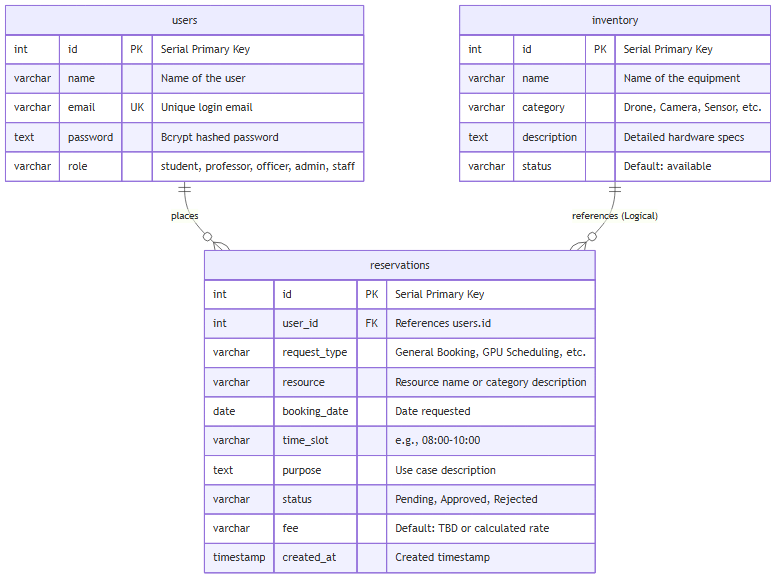
The diagram below details the physical database model (based on PostgreSQL) and illustrates the logical relationships between the core entities: users, inventory, and reservations.
Click to expand Mermaid Source Code</summary>
erDiagram
    users {
        int id PK "Serial Primary Key"
        varchar name "Name of the user"
        varchar email UK "Unique login email"
        text password "Bcrypt hashed password"
        varchar role "student, professor, officer, admin, staff"
    }

    inventory {
        int id PK "Serial Primary Key"
        varchar name "Name of the equipment"
        varchar category "Drone, Camera, Sensor, etc."
        text description "Detailed hardware specs"
        varchar status "Default: available"
    }

    reservations {
        int id PK "Serial Primary Key"
        int user_id FK "References users.id"
        varchar request_type "General Booking, GPU Scheduling, etc."
        varchar resource "Resource name or category description"
        date booking_date "Date requested"
        varchar time_slot "e.g., 08:00–10:00"
        text purpose "Use case description"
        varchar status "Pending, Approved, Rejected"
        varchar fee "Default: TBD or calculated rate"
        timestamp created_at "Created timestamp"
    }

    %% Relationships
    users ||--o{ reservations : "places"
    inventory ||--o{ reservations : "references (Logical)"
</details>
Entity Mappings & Specifications
1. Users Entity (users)
Stores profile and credentials of all users interacting with the laboratory system.
id: Primary key (automatically incremented).name: User’s full name.email: User’s university email, enforced with a UNIQUE constraint. Used for logins and emails.password: Secure Bcrypt password hash.role: User permission level (student, professor, officer, admin, staff), validated via a check constraint.
2. Inventory Entity (inventory)
Tracks the laboratory’s hardware, devices, and high-value compute resources.
id: Primary key (automatically incremented).name: Label or model of the device (e.g., “DJI Matrice 300 RTK”).category: Classification (e.g., “Drone”, “Camera”, “Computing”, “Sensor”).description: Description of item technical specs or characteristics.status: Availability tracker (e.g., available, borrowed, maintenance).
3. Reservations Entity (reservations)
Registers all booked resources, time frames, and processing stages.
id: Primary key (automatically incremented).user_id: Foreign key referencing users.id with ON DELETE CASCADE enabled.request_type: Type of the booking request (e.g., General Booking, GPU Scheduling).resource: Resource identifier (logically refers to a specific inventory item or a service).booking_date: Requested reservation date.time_slot: Targeted scheduling interval.purpose: Context of usage.status: Lifecycle stage (Pending, Approved, Rejected).fee: Tracked cost of reservation (Default: “TBD”).created_at: The exact time the booking request was submitted.
Relationship Integrity Rules
- User to Reservation (One-to-Many):
- A user can place zero or many reservations.
- Each reservation is associated with exactly one user.
- Referential integrity is maintained by a foreign key constraint (
user_id REFERENCES users(id)).
ON DELETE CASCADE is set so that deleting a user profile automatically deletes all their related reservation histories.
- Inventory to Reservation (Logical One-to-Many):
- The
reservations.resource string maps logically to the inventory.name or category.
- This is kept as a loose logical connection rather than a strict database foreign key to allow flexible scheduling of virtual assets (such as “Lab Space Access” or “Consultation sessions”) that are not registered in the hardware inventory table.
erDiagram
users {
int id PK "Serial Primary Key"
varchar name "Name of the user"
varchar email UK "Unique login email"
text password "Bcrypt hashed password"
varchar role "student, professor, officer, admin, staff"
}
inventory {
int id PK "Serial Primary Key"
varchar name "Name of the equipment"
varchar category "Drone, Camera, Sensor, etc."
text description "Detailed hardware specs"
varchar status "Default: available"
}
reservations {
int id PK "Serial Primary Key"
int user_id FK "References users.id"
varchar request_type "General Booking, GPU Scheduling, etc."
varchar resource "Resource name or category description"
date booking_date "Date requested"
varchar time_slot "e.g., 08:00–10:00"
text purpose "Use case description"
varchar status "Pending, Approved, Rejected"
varchar fee "Default: TBD or calculated rate"
timestamp created_at "Created timestamp"
}
%% Relationships
users ||--o{ reservations : "places"
inventory ||--o{ reservations : "references (Logical)"
users)id: Primary key (automatically incremented).name: User’s full name.email: User’s university email, enforced with a UNIQUE constraint. Used for logins and emails.password: Secure Bcrypt password hash.role: User permission level (student, professor, officer, admin, staff), validated via a check constraint.inventory)id: Primary key (automatically incremented).name: Label or model of the device (e.g., “DJI Matrice 300 RTK”).category: Classification (e.g., “Drone”, “Camera”, “Computing”, “Sensor”).description: Description of item technical specs or characteristics.status: Availability tracker (e.g., available, borrowed, maintenance).reservations)id: Primary key (automatically incremented).user_id: Foreign key referencing users.id with ON DELETE CASCADE enabled.request_type: Type of the booking request (e.g., General Booking, GPU Scheduling).resource: Resource identifier (logically refers to a specific inventory item or a service).booking_date: Requested reservation date.time_slot: Targeted scheduling interval.purpose: Context of usage.status: Lifecycle stage (Pending, Approved, Rejected).fee: Tracked cost of reservation (Default: “TBD”).created_at: The exact time the booking request was submitted.- A user can place zero or many reservations.
- Each reservation is associated with exactly one user.
- Referential integrity is maintained by a foreign key constraint (
user_id REFERENCES users(id)). ON DELETE CASCADEis set so that deleting a user profile automatically deletes all their related reservation histories.
- The
reservations.resourcestring maps logically to theinventory.nameor category. - This is kept as a loose logical connection rather than a strict database foreign key to allow flexible scheduling of virtual assets (such as “Lab Space Access” or “Consultation sessions”) that are not registered in the hardware inventory table.